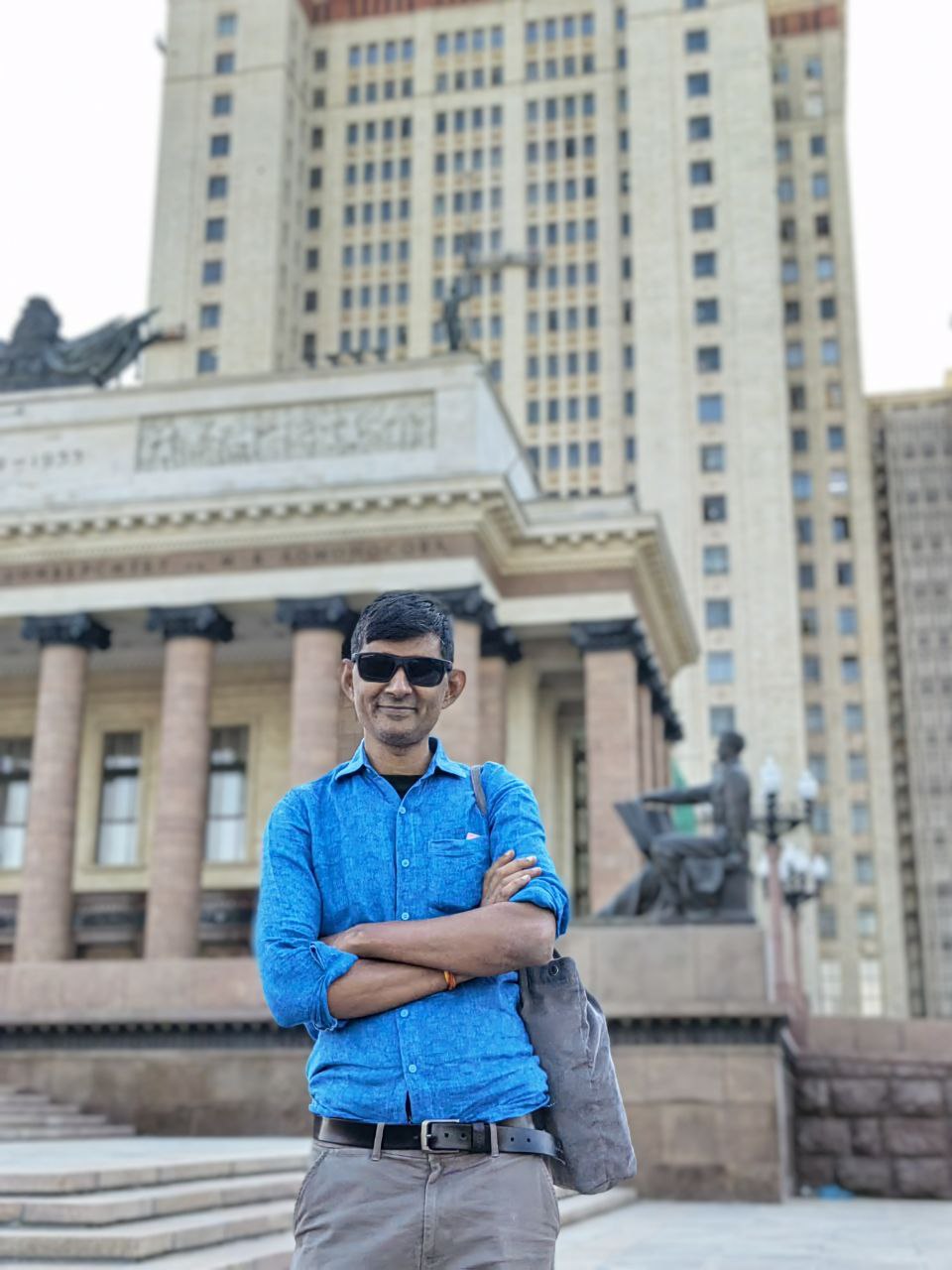
Abhishek Singh
Abhishek SinghLaywer · AI Educator · Author · Founder, NeuralCrowd
Lawyer AI Educator Author · 5 Books IT Consultant · 30+ yrs Founder · ICT
About the Author

Abhishek Singh

Laywer · AI Educator · Author · Founder,
5K+
Trained
50+
Countries
5
Books
30+
Years
Why He Wrote This Book

For thirty years, I watched intelligent people struggle to reach their potential — not because they lacked ability, but because no one had ever shown them how to learn.

I watched engineers who couldn't remember what they'd studied last week. Students who worked sixteen-hour days and still failed their exams. Professionals re-learning the same material they'd supposedly mastered years before.

And then I looked at the Vedic tradition — the one that preserved the entire Upanishads, the Vedas, the Mahabharata in human memory without writing, for generations. Without textbooks. Without spaced repetition apps. Without AI. Without any of the tools we consider essential today.

The Gurukul system produced students who could recall thousands of slokas word-perfectly, solve complex mathematics, debate philosophy at the highest level, and apply knowledge in real-world contexts — all before modern neuroscience existed to explain why their methods worked.

I spent three years mapping the gap between those two worlds. What I found became VOLEX.

— Abhishek Singh on writing The Augmented Student
The Gap That Inspired VOLEX
Modern education is extraordinarily good at delivering content. Textbooks, lectures, online courses, YouTube — the information has never been more accessible. Yet learning outcomes have not kept pace. Students have access to more knowledge than any generation in history, and many still cannot remember what they studied last week.
The gap, Abhishek discovered, is not in the content. It is in the operating system. Students are being given enormous amounts of information without being taught how to process, retain, structure, execute on, or augment that information using the tools available to them.
The Vedic tradition solved this problem 5,000 years ago by teaching the student's mind first, and content second. The Augmented Student exists to restore this sequence — using the ancient science of the Chitta and Samskaras alongside modern cognitive research and AI-powered study tools.
"Every student deserves to know how to learn. Not just what to learn — but how to encode it, retain it, structure it, execute on it, and amplify it with intelligence. This book is my attempt to give that to every student on earth."
— Abhishek Singh · The Augmented Student, Preface
His Learning Philosophy
1
Identity before technique
A student who believes they cannot learn will not learn, regardless of method. The VOLEX system installs the student's identity first — in Chapter 1, before any technique is introduced.
2
Ancient wisdom is not outdated
Vedic learning traditions were built through 5,000 years of direct experimentation on human cognition. Most are validated by modern neuroscience. None should be discarded as pre-scientific.
3
AI amplifies — it does not replace
The X pillar of VOLEX is the last pillar, not the first. A student who has not built the human pillars (V, O, L, E) will use AI as a crutch. One who has will use it as a force multiplier.
4
Consistency over intensity
Abhyasa (sustained, disciplined practice) produces more than burst effort. One focused hour daily for 90 days transforms more than ten-hour panic sessions the week before an exam.
5
Learning is a lifelong identity
The Augmented Student is not a book about passing exams. It is about becoming someone who learns — who will keep learning long after the exam, the degree, and the institution are gone.
The VOLEX Origin Story
🔍
The Observation · 30 Years
Watching thousands of professionals fail to retain learning
Across 30+ years in IT consulting and professional training, Abhishek observed a consistent pattern: intelligent, motivated people struggling to apply what they had studied. The failure was not intellectual — it was structural.
📚
The Research · 3 Years
Mapping Vedic pedagogy against modern cognitive science
Deep study of the Gurukul system, Vedic epistemology (Chitta, Samskaras, Dharana, Abhyasa, Bhavana), alongside Ebbinghaus, Roediger, Dweck, Newport, and Langer. Finding the convergence points between 5,000-year-old methods and 21st-century neuroscience.
The Framework · The VOLEX Name
Five pillars, one complete student operating system
VOLEX emerged as the organising architecture: Vedic Vitality (Rewire), Optimal Recall (Remember), Logical Architecture (Structure), Executive Execution (Execute), X-Intelligence (Augment). Five sequential, interdependent pillars that mirror the Gurukul's sequence — identity, memory, knowledge, performance, transcendence.
✍️
The Book · Coming 2025–26
The Augmented Student: Vedic to AI Era
29 chapters, 6 parts, ~418 pages. Every chapter builds on the last. Every Vedic concept is paired with its modern scientific equivalent and its AI-powered application. Built to serve every student, in every country, at every level — from school to competitive examinations to lifelong learning.
Get the Book → Take the Diagnostic Full Bio →
Also by Abhishek Singh
Four published books — available now across 8 platforms worldwide.
The Augmented Student · Coming 2025–26

Ready to become the student
you were always capable of being?

Join the waitlist. Get Chapter 0 free on launch day. Find your weakest VOLEX pillar and start before the book is even published.